How to Fix Bedhead Without Washing Your Hair Again
You went to bed with clean, styled hair. Eight hours later, one side is flat, the roots are compressed, and the shape no longer works.
That does not always mean your hair needs another wash.
Sometimes the problem is simply what your pillow changed overnight. If the hair is still clean but the structure has collapsed, the fastest solution is usually not to restart your entire routine. It is to reset the areas that actually changed.
BEDHEAD ISN’T ALWAYS A DIRTY-HAIR PROBLEM.
Morning bedhead is often mechanical. While you sleep, pressure and friction can push hair in a different direction, compress volume at the roots and flatten sections that were sitting correctly the night before.
The result can look worse than it really is. Your hair may still be clean. The style may still be mostly intact. But one side has been pressed down, the fringe is pointing somewhere new, or the crown has lost its lift.
This distinction matters because the solution should match the problem. If your hair needs cleansing, wash it. If it is simply compressed or out of shape, a targeted reset may be enough.
WHEN TO RESET — AND WHEN TO WASH.
A no-wash reset makes the most sense when the issue is shape rather than cleanliness. Think flattened roots, pillow lines, compressed sections or hair that has been pushed out of direction overnight.
A normal wash still makes sense when your scalp or hair actually needs cleaning — for example after heavy sweating, obvious oil buildup or a lot of styling product. A reset should not replace normal cleansing when cleansing is what you need.
That boundary is important. The goal is not to avoid washing your hair at all costs. It is to stop restarting a full wash-and-style routine when the only thing that changed was the shape.
HOW TO FIX BEDHEAD WITHOUT STARTING OVER.
1. Identify the areas that actually changed.
Before reaching for water or product, look at the hair as a whole. Is everything wrong, or is the problem concentrated in two or three areas?
Most morning corrections are more targeted than they first appear. One side may be compressed. The crown may be flat. A front section may have been pushed in the wrong direction. Starting with those areas keeps the reset controlled and avoids making clean hair unnecessarily wet.
2. Add only as much moisture and texture as you need.
More product is not automatically better. Saturating the hair can turn a quick correction into another drying and styling session.
Start light. Apply only to the areas that need resetting, then add more if the hair still needs help. The aim is to make the hair workable again, not soaked.
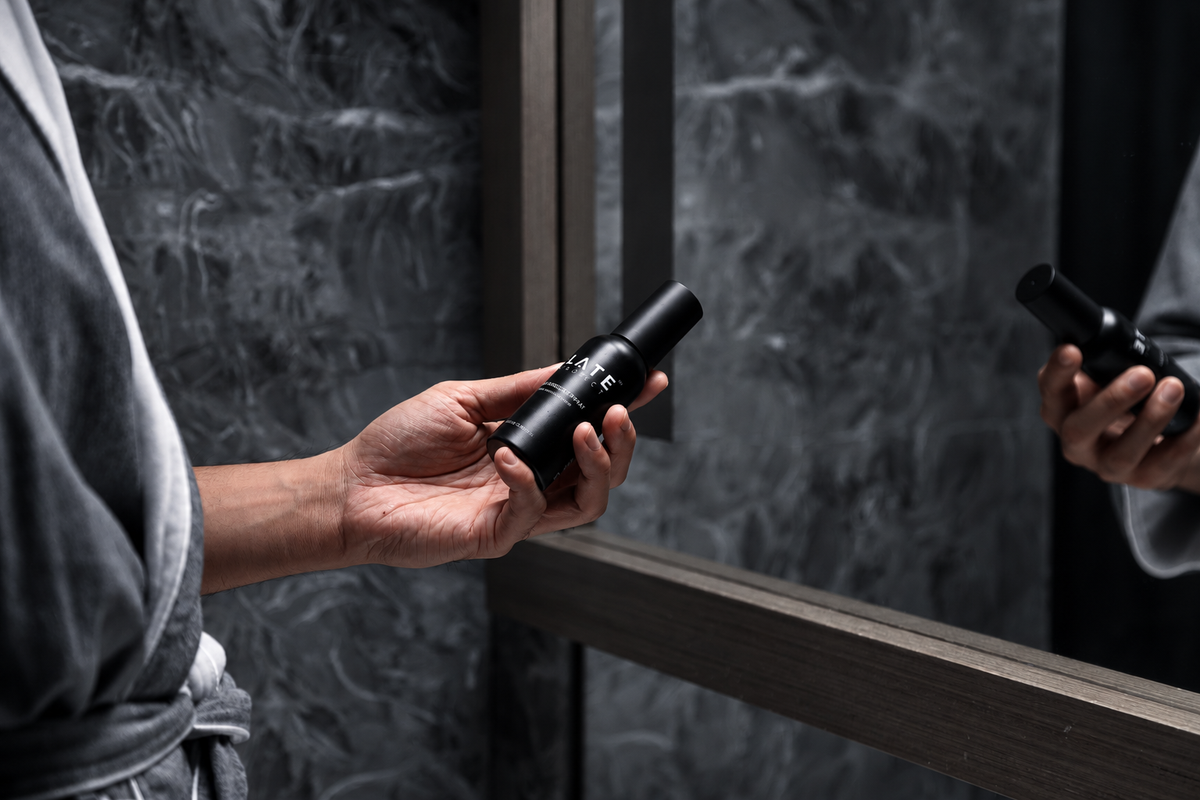
This is one reason SLATE Hair Reset Spray is designed around a fast-dry, matte, non-greasy profile rather than the feel of a conventional wet styling spray. It is built for correction first, not maximum hold.
3. Restore direction before chasing volume.
Bedhead is often a direction problem disguised as a volume problem. If the hair is lying the wrong way, simply trying to make it bigger can create more disorder.
Use your fingers or a comb to guide the compressed sections back toward the direction you actually wear them. Work through the roots and the affected lengths, then rebuild lift once the basic shape is back where it belongs.
For SLATE, this is the role of the Carbon-Fiber Comb: SHAPE. The spray makes the hair workable; the comb helps put structure and direction back into the reset.
4. Let the hair dry down before judging the result.
Do not keep adding product while the hair is still settling. Give the reset a moment to dry down, then look again.
You are looking for a natural, workable shape: the compressed areas lifted, the direction corrected and the hair ready to leave alone — or ready for the final product you normally use.
5. Add stronger hold only if your hairstyle needs it.
A reset and a strong-hold styler do different jobs.
If you wear a more structured hairstyle, finish with your usual wax, clay or paste after the reset. SLATE is designed for light, flexible structure rather than locking the hair into place.
That separation keeps the routine more precise: first restore what sleep changed, then style only as much as your finished look requires.
SPRAY. COMB. GO.
SLATE was built around this exact distinction.
RESET — Hair Reset Spray. Target the compressed, flat or out-of-shape areas. Start light rather than saturating the hair.
SHAPE — Carbon-Fiber Comb. Work the affected areas back into direction, texture and natural lift.
READY — Tactical Sleeve. Keep the tools together, protected and ready for the next morning.
Two tools perform the reset. The sleeve keeps the system ready.
We call it the 30-Second Hair Reset Protocol because the routine is designed to stay narrow and fast. The exact time will vary with hair length, density and how much correction is needed. The point is not to race a stopwatch. The point is to avoid rebuilding a hairstyle that did not need rebuilding.
WHAT A GOOD RESET SHOULD LOOK LIKE.
The result should not look like you coated your hair in product.
For a typical bedhead reset, you are looking for restored direction, natural lift, medium texture and a matte, non-greasy finish. The hair should remain workable rather than rigid.
If you need dramatic hold, a glossy finish or a completely new hairstyle, use the products and routine built for those jobs. Morning Bedhead Reset is deliberately narrower.
RESET. DON’T RESTART.
A lot of grooming routines become longer because every small problem triggers the full solution.
Bedhead does not always require that.
If your hair is dirty, wash it. If your style needs serious rebuilding, restyle it. But if your hair is still clean and the pillow simply flattened the parts that were working yesterday, fix those parts and move on.
That is the idea behind SLATE: identify what changed, reset only that, and get on with the morning.